Friday, June 05, 2009
Come Grow With Me: Glaucoma
Someone asked me before, what is blogging to me? I think (and hope) everyone goes away with something after spending 10 minutes reading my entries. Apart from my complains and thoughts, I hope I can share as much things things I know with everyone. Life's too short, and there is too much knowledge out there. Hopefully my blog gives most a short-cut to learning new things.
Anyway, I have glaucoma. And it did get me stressed from time to time. So if there is one thing I hope everyone will do, it is to do an eye check up. I had my check up done when I was making a new pair of glasses. I go to Pearl Optics (101 Upper Cross Street, #02-22~25 People's Park Centre, Singapore 058357. Tel: 65330232 / 65325110). The services are free to customers. Alternatively, any clinics can give you a referral to the eye clinic.
Before this incident, I thought glaucoma is an old person's disease. Later I found out that most of us people have this misconception because we always hear of old people with this disease. Please remember that most patients have the condition since young, but only found out when it's too late.
Introduction
Glaucoma accounts for 40% of blindness in Singapore. It is an eye disease where the fluid pressure within the eyeball is too high and damages the optic nerve, which carries visual impulses from the eye to the brain. This pressure build-up occurs because of an imbalance between the production and drainage of fluid within the eyeball.
Glaucoma can be divided roughly into two main categories, "open angle" and "closed angle" glaucoma. Angle closure can appear suddenly and is often painful. Visual loss can progress quickly but the discomfort often leads patients to seek medical attention before permanent damage occurs. Open angle, chronic glaucoma tends to progress more slowly and the patient may not notice that they have lost vision until the disease has progressed significantly.
Glaucoma has been nicknamed the "sneak thief of sight" because the loss of vision normally occurs gradually over a long period of time and is often only recognized when the disease is quite advanced. Once lost, this damaged visual field can never be recovered. Worldwide, it is the second leading cause of blindness. Glaucoma affects one in two hundred people aged fifty and younger, and one in ten over the age of eighty. If the condition is detected early enough it is possible to arrest the development or slow the progression with medical and surgical means.
Symptoms
There are rarely any symptoms in the early stages of the disease so it is important to have regular eye checks by a qualified professional. Ophthalmologist and optometrists will diagnose glaucoma on the basis of intraocular pressure, visual field results and optic nerve head appearance.
Patients will sometimes notice patchy loss of peripheral vision or reduced contrast sensitivity and these people may benefit from a review by an eye specialist.
Symptoms of angle closure glaucoma can include pain in or behind the eye ball, headache with nausea and vomiting and visual disturbances with halos around lights but sometimes there are no symptoms.
How is glaucoma treated?
Glaucoma can be treated but not cured. Once the optic nerve is damaged, the loss of vision is permanent. The aim of the treatment is to lower the intraocular pressures to an acceptable level, thus preventing further damage to the optic nerve. Because treatment can only control but not cure the condition, it must be continued throughout life.
Treatment depends on the type of glaucoma, and may be in the form of medication (eyedrops or tablets), surgery or laser.
Singapore National Eye Clinic
Labels: Come Grow With Me


Tuesday, July 08, 2008
Signs You Don't Want The Job
You've heard it all before: When you have a job interview it's important to come on time, dress right and project a positive attitude. What people always seem to forget, however, is that it's crucial that you also use this opportunity to get a sense of your potential employer. After all, what good is an offer from a company you'd desperately want to leave after just a few days? The next time you embark on an interview for employment, make sure you watch for these signs you don't want the job.
1. The interview takes place off-site
Obviously, if you're applying for a field position abroad or in a different city, chances are the interview will have to occur in a public place. However, if the company has a local office and the interviewer still insists on meeting you at a bar or a restaurant, you should consider it one of the signs you don't want the job. Some employers resort to this practice when they're trying to hide something about the office environment, while others use the casual setting to make unethical deals, which is a strong indication of the kind of boss you'd get.
2. The interviewer is late or ill-prepared
Companies tend to treat candidates with more care than actual employees, so if a manager doesn't have time to conduct a proper interview, you can be sure that he or she won't have time to give you thorough training and regular feedback once you're hired. By the same token, if the interview keeps getting delayed, it usually means the company is undergoing massive changes and the job in the posting might not be the one you'd actually get. Worse, it may be an indication that the ship is sinking, thus making it one of the more alarming signs you don't want the job.
3. Interview conducted with other candidates present
Though this practice is often disguised as progressive management, a group interview is really just a way for lazy managers to save time by meeting several candidates at once. If employers can't even take their hiring policies seriously, don't expect them to treat the staff with any respect. Another reason this is one of the signs you don't want the job is that the process overlooks quiet, efficient workers in favor of loudmouths and braggarts. Just imagine the kind of office you'd be joining.
4. The interviewer competes with you
Even the most egomaniacal managers know not to insult potential employees during the selection process, but there are ways to recognize bad bosses even when they're on their best behavior: Candidates are expected to sell themselves during interviews, so whenever you say something positive about yourself, carefully observe the interviewer's reaction for signs you don't want the job. If the latter corrects you or responds by boasting about his or her own accomplishments, then you're dealing with an employer who's putting personal pride over finding the right candidate for the job. This should tell you all you need to know about the type of management you can expect from that company.
5. The interviewer complains
Though it's often considered an indication that you've nailed the interview, an employer sharing his or her frustrations about the office is another one of the signs you don't want the job. Don't be fooled by the illusion of complicity; a supervisor who badmouths the staff or former subordinates during the interview is likely to do the same to you once you're hired. Furthermore, if legitimate, these complaints might be the tip of the iceberg, in which case you'd be stepping into a work environment so toxic even the managers are fed up.
6. The interviewer asks inappropriate questions
Don't let your desire to impress the interviewer blind you to one of the most obvious signs you don't want the job: Even the most experienced interviewers will occasionally goof by inquiring about your personal life or confidential aspects of your current position. However, if it becomes a recurring theme, you may be looking at harassment down the line. When dealing with an inappropriate question, ask your potential employer to elaborate on his or her concerns. If the interview gets immediately back on track, then the faux pas was probably an innocent mistake. Note, however, that inquiries regarding sex, race and religion are never innocent.
7. Rewards of the job are overemphasized
Even when dealing with headhunters, interviews should always focus on job skills, office culture and career opportunities. Employers who neglect these topics in favor of boasting about company perks and high salaries indicate that they don't care what kind of candidate you are as long as you sign the contract, which is one of the major signs you don't want the job. Similarly, you should be wary of interviewers who pressure you to accept the position right away. Ask yourself: What is the company trying to hide, and why is it so desperate?
8. They request you work a trial day
The reason a trial day is considered one of the signs you don't want the job is that the practice doesn't make much sense. It usually takes at least a week to fully train a new employee, so it seems absurd to let candidates who haven't even committed to the company interact with clients and affect production for only one day. If the objective is to protect the office from bad hires, the employer should simply impose a probation period. Trial days are indicative of either poor management or a dead-end job. In the sales sector, they're even associated with pyramid schemes.
pay attention to the signs
These signs you don't want the job will help you steer clear of bad bosses, toxic office environments and dead-end career paths. However, the best way to learn about your potential employer is to ask questions about the position and the office culture during the interview. This has the benefit of showing that you're interested but not desperate. More importantly, though, you may save yourself a lot of grief by uncovering important issues before you commit to the company.
Labels: Come Grow With Me
Friday, January 11, 2008
Come Grow With Me: The Singapore Flyer
 For a start, it is not the Singapore Eye...
The Singapore Flyer (新加坡摩天观景轮) is a giant observation wheel in Singapore and slated for an opening on March 1, 2008.
The 165 metres (42 stories high) structure is being built by Singapore-based company Great Wheel Corp. And it costs S$240 million. It will exceed The Star of Nanchang (currently the tallest) by 5 metres and the London Eye (currently the largest) by 30 metres. It will feature 28 air-conditioned capsules capable of holding 30 passengers each. A complete rotation of the wheel will take an estimated 37 minutes.
The cheapest adult ticket is S$29.50.
It is already expected that the Singapore Flyer will be a hit with its Valentine's Day and Chinese New Year packages. And probably also when the Singapore Grand Prix (Formula One) comes to Singapore on 28 September 2008.
Link: Singapore Flyer Official Site
Link: Wikipedia
Labels: Come Grow With Me
Monday, February 12, 2007
Come Grow With Me: 7 Pains You Shouldn't Ignore
By Leanna Skarnulis
WebMD Feature
Whoever coined the term "necessary evil" might have been thinking of pain. No one wants it, yet it's the body's way of getting your attention when something is wrong. You're probably sufficiently in tune with your body to know when the pain is just a bother, perhaps the result of moving furniture a day or two before or eating that third enchilada. It's when pain might signal something more serious that the internal dialogue begins:
"OK, this isn't something to fool around with."
"But I can't miss my meeting."
"And how many meetings will you miss if you land in the hospital?"
"I'll give it one more day."
Etc.
You need a guide. WebMD consulted doctors in cardiology, internal medicine, geriatrics, and psychiatry so you'll understand which pains you must not ignore -- and why. And, of course, if in doubt, get medical attention.
No. 1: Worst Headache of Your Life
Get medical attention immediately. "If you have a cold, it could be a sinus headache," says Sandra Fryhofer, MD, MACP, spokeswoman for the American College of Physicians. "But you could have a brain hemorrhage or brain tumor. With any pain, unless you're sure of what caused it, get it checked out."
Sharon Brangman, MD, FACP, spokeswoman for the American Geriatrics Society, tells WebMD that when someone says they have the worst headache of their life, "what we learned in medical training was that was a classic sign of a brain aneurysm. Go immediately to the ER."
No. 2: Pain or Discomfort in the Chest, Throat, Jaw, Shoulder, Arm, or Abdomen
Chest pain could be pneumonia or a heart attack. But be aware that heart conditions typically appear as discomfort, not pain. "Don't wait for pain," says cardiologist Jerome Cohen, MD. "Heart patients talk about pressure. They'll clench their fist and put it over their chest or say it's like an elephant sitting on their chest."
The discomfort associated with heart disease could also be in the upper chest, throat, jaw, left shoulder or arm, or abdomen and might be accompanied by nausea. "I'm not too much worried about the 18-year-old, but if a person has unexplained, persistent discomfort and knows they're high risk, they shouldn't wait," says Cohen. "Too often people delay because they misinterpret it as [heartburn] or GI distress. Call 911 or get to an emergency room or physician's office. If it turns out to be something else, that's great."
He tells WebMD that intermittent discomfort should be taken seriously as well. "There might be a pattern, such as discomfort related to excitement, emotional upset, or exertion. For example, if you experience it when you're gardening, but it goes away when you sit down, that's angina. It's usually worse in cold or hot weather."
"A woman's discomfort signs can be more subtle," says Cohen, who is director of preventive cardiology at Saint Louis University School of Medicine. "Heart disease can masquerade as GI symptoms, such as bloating, GI distress, or discomfort in the abdomen. It's also associated with feeling tired. Risk for heart disease increases dramatically after menopause. It kills more women than men even though men are at higher risk at any age. Women and their physicians need to be on their toes."
No. 3: Pain in Lower Back or Between Shoulder Blades
"Most often it's arthritis," says Brangman, who is professor and chief of geriatrics at SUNY Upstate Medical University in Syracuse, N.Y. Other possibilities include a heart attack or abdominal problems. "One danger is aortic dissection, which can appear as either a nagging or sudden pain. People who are at risk have conditions that can change the integrity of the vessel wall. These would include high blood pressure, a history of circulation problems, smoking, and diabetes."
No. 4: Severe Abdominal Pain
Still have your appendix? Don't flirt with the possibility of a rupture. Gallbladder and pancreas problems, stomach ulcers, and intestinal blockages are some other possible causes of abdominal pain that need attention.
No 5: Calf Pain
One of the lesser known dangers is deep vein thrombosis (DVT), a blood clot that can occur in the leg's deep veins. It affects 2 million Americans a year, and it can be life-threatening. "The danger is that a piece of the clot could break loose and cause pulmonary embolism [a clot in the lungs], which could be fatal," says Fryhofer. Cancer, obesity, immobility due to prolonged bed rest or long-distance travel, pregnancy, and advanced age are among the risk factors.
"Sometimes there's just swelling without pain," says Brangman. "If you have swelling and pain in your calf muscles, see a doctor immediately."
No. 6: Burning Feet or Legs
Nearly one-third of the 20 million Americans who have diabetes are undiagnosed, according to the American Diabetes Association. "In some people who don't know they have diabetes, peripheral neuropathy could be one of the first signs," says Brangman. "It's a burning or pins-and-needles sensation in the feet or legs that can indicate nerve damage."
No 7: Vague, Combined, or Medically Unexplained Pains
"Various painful, physical symptoms are common in depression," says psychiatrist Thomas Wise, MD. "Patients will have vague complaints of headaches, abdominal pain, or limb pain, sometimes in combination."
Because the pain might be chronic and not terribly debilitating, depressed people, their families, and health care professionals might dismiss the symptoms. "Furthermore, the more depressed you are, the more difficulty you have describing your feelings," says Wise, who is the psychiatry department chairman at Inova Fairfax Hospital in Fairfax, Va. "All of this can lead the clinician astray."
Other symptoms must be present before a diagnosis of depression can be made. "Get help when you've lost interest in activities, you're unable to work or think effectively, and you can't get along with people," he says. "And don't suffer silently when you're hurting."
He adds there's more to depression than deterioration of the quality of life. "It has to be treated aggressively before it causes structural changes in the brain."
Labels: Come Grow With Me
Monday, July 17, 2006
Come Grow With Me: Sun Protection
● 50-80% of our lifetime sun-exposure occurs before age 18.
● Many parents use only 50% of the optimal amount of sunscreen and often neglect to reapply it as the day goes on.
● Early sun exposure is related to aging skin, wrinkles, and the later development of skin cancers. The most deadly, melanoma, has continued to increase over the past decades, perhaps because:
● NEWSFLASH! It is now felt that exposure to UVA ultraviolet rays may be more important in causing later skin cancer. Many sunscreens do not provide adequate protection against UVA!
******************************************
● The sun contains three kinds of ultraviolet (UV - light with very short wavelengths) rays: UVA, UVB, UVC. (UVC rays are apparently the most dangerous but, at least for now, are blocked by the ozone layer and don't penetrate the earth's surface.)
UV rays interact with and are absorbed by your skin's pigment cells (melanocytes) . More UV --> more melanin to protect the surrounding skin from burns --> suntan.
● However, there is no such thing as complete protection from UV rays.
● The sun's rays are strongest in the summer, especially between 10am and 4pm. (Use the "shadow rule": when your shadow is shorter than you are, the UV rays are most intense.)
● UV rays reflect off water and snow, increasing exposure.
● 2/3 of UV rays penetrate clouds and can cause unexpected sunburns.
● The "SPF" (sun protection factor) on sunscreens estimates how well the UV rays are blocked from reaching the skin. A factor of "15" means that sun exposure of 15 minutes is equivalent to about 1 minute exposure without sunscreen. An SPF of 10 blocks about 90% of UVB, a SPF of 15 blocks 93%, and an SPF of 30 blocks 97%.
● However, SPF refers to the ability to block UVB, not UVA!
****************************************
Tips on protection from harmful rays.
● Wear sun-protective clothing. Look for summer clothing with Ultraviolet Protection Factor (UPF - similar to SPF in sunscreen) of 15 or greater on the label. (These can lose effectiveness if wet, stretched, or too tight.)
● Wear caps/hats with broad bills that shade the face, head, neck and ears.
● Use sunglasses with both UVA and UVB protection (Cataracts as an adult may, in part, be related to early unprotected eye exposure to UV rays).
● Play in the shade. Bring an umbrella or pop-up tent along to avoid direct sun.
● No sunbathing! Remember: tan skin is damaged skin.
● Use sunscreen liberally.
● Pick a PABA-free "hypoallergenic" sunscreen that offers both UVA and UVB protection.
● All sunscreens block UVB , but not all do a good job with UVA. Read the label: the best UVA protectors contain a chemical-free sun "blocker" (like zinc oxide, titanium dioxide) and/or the sunscreen avobenzone.
● Use a sunscreen with an SPF of 15 or more whenever your child is exposed to the sun.
● An SPF of more than 30 is not necessarily better, as the increased concentration of suncreen is more likely to cause skin irritation while offering very little extra protection (e.g., increasing SPF from 30 to 40 requires 25% more sunscreen with only 0.8% more protection).
● Apply sunscreen liberally and let dry about 30 minutes before exposure.
● Don't forget the nooks, crannies, and high-exposure areas (ears, feet, lips, noses).
● Remember: "water resistant" means it lasts about 40 minutes in the water; "water proof" means it wears off after about 80 minutes in the water. So, reapply, reapply, reapply (every 2-3 hours, or right after swimming or sweating a lot), as the day wears on.
● If you read the labels, you'll see there isn't much difference (except cost) in sunscreens marketed for kids. Don't feel obliged to use them, unless one especially appeals to your child.
**************************************
Sunburn is caused by the high energy of the UV rays directly burning the exposed skin. It usually shows up 2-6 hours after exposure and peaks in severity at about 24 hours. Alas, no treatment (except avoiding further sun exposure) has been shown to reduce the extent of the damage or the time of healing.
For comfort, here are some tips:
● Take a cool bath (some find adding baking soda or oatmeal to be soothing).
● Gently apply cool, wet compresses.
● Rub on soothing aloe vera gel.
● Use a fragrance-free moisturizing cream (not petroleum-based) to rehydrate the skin.
● If severe, 1% hydrocortisone cream may offer some relief (although, alas, it usually doesn't in my experience).
● Give a pain reliever which also reduces inflammation (such as ibuprofen).
● Drink plenty of fluids.
● While rare, if the sunburn is especially severe and/or accompanied by other symptoms (like severe pain, horrible blisters, nausea, confusion, headache, looking infected over time), seek medical attention!
Labels: Come Grow With Me
Sunday, June 18, 2006
Seven Signs It's Time to Toss Your Résumé
They've reviewed millions of résumés and seen it all. From the candidate whose stated objective was to "seek a high-paying, relaxing job" to the software developer who included a photo of himself bare-chested, cavorting in the surf.
Corporate recruiters say you'd be surprised at how many candidates leave out important facts, such as the names and locations of companies where they've worked, or include too much information, like the candidate who asterisked her dates of employment with the caveat: "Please do not misconstrue the fact that I have had 12 jobs in six years as job-hopping...I have never quit a job!"
Is your résumé working for you or against you? Here are seven signs it may be time to tweak (or toss) your résumé:
1. No Career Summary/Introductory Statement
Most hiring companies don't have time to match unspecified résumés to open positions, so lead off with a career summary or introductory statement that makes it clear what type of position you are seeking and why you are qualified for the job.
2. Lack of Keywords and Phrases
To pass through a company's applicant tracking software, your résumé must contain the keywords and phrases it is screening for. These words are not the verbs stressed in paper résumés, but nouns such as job titles and technical skills.
To find out what keywords you should be using, read the job posting or obtain the actual job description. You also may want to check out the book 2,500 Keywords to Get You Hired by Jay Block and Michael Betrus, which lists critical keywords for each career and shows examples of how to use them in your résumé.
3. No Evidence of Your Experience
Your résumé should not merely list the jobs you've held; it should provide specific examples of how you achieved success. Résumé-writing professionals recommend using the PARS formula: Describe a Problem, the Action you took, the Results you achieved and Skills you applied.
4. Use of Personal Pronouns and Articles
With just two pages to sell yourself, make each word count. Write in a telegraphic style, eliminating all personal pronouns and articles like "the," "a" and "an." Removing the "I," "me" and "my" from your résumé not only frees up space, but creates a subliminal perception of objectivity.
5. Irrelevant Information
Irrelevant information keeps the reader from seeing your selling points. Weigh each portion of your experience from the hiring company's perspective to decide what to include and what to emphasize. If you're applying for an engineering position, for example, don't devote a whole paragraph to your job as a camp counselor unless the position has elements that are transferable to the engineering job. And never include information about your marital status, personal situation, hobbies or interests unless they are relevant to the job for which you're applying.
6. Poor Formatting
Unless you have no work experience or have held a number of different jobs in a short amount of time, a chronological résumé is the most effective. That means using the following order:
Since poor alignment, spacing and use of bolding and caps make a résumé hard to read, you may want to use a résumé template.
7. Typos and Misspelled Words
From the would-be administrative assistant who claimed to be a "rabid typist" to the executive who boasted that he was "instrumental in ruining the entire operation," misspellings communicate that you have poor writing skills or a lackadaisical attitude. Proofread your résumé carefully and have several friends and family members read it as well.
Last, remember that the purpose of your résumé is to communicate your experiences and accomplishments as they relate to an open position and to obtain a job interview. Because each situation is different, you should tailor your résumé to each opportunity.
Labels: Come Grow With Me
Tuesday, May 09, 2006
Importance of knowing the signs of a stroke
RECOGNIZING A STROKE:
Sometimes symptoms of a stroke are difficult to identify. Unfortunately, the lack of awareness spells disaster. The stroke victim may suffer severe brain damage when people nearby fail to recognize the symptoms of a stroke. Now doctors say a bystander can recognize a stroke by asking three simple questions:
*Ask the individual to SMILE.
*Ask the person to TALK, to SPEAK A SIMPLE SENTENCE. (Coherently, e.g It is sunny out today)
*Ask him or her to RAISE BOTH ARMS.
NOTE: Another 'sign' of a stroke is this: Ask the person to 'stick' out their tongue. If the tongue is 'crooked', if it goes to one side or the other, that is also an indication of a stroke.
If he or she has trouble with any one of these tasks, call for an ambulance immediately and describe the symptoms to the dispatcher.
Labels: Come Grow With Me
Saturday, April 29, 2006
I think Singaporeans Should Know These Too
 The Flag of Singapore consists of two horizontal halves, red above white. Red symbolises universal brotherhood and equality of man; white stands for pervading and everlasting purity and virtue. In the upper left corner, a white crescent moon and five white stars form a circle. The crescent moon represents a young nation on the rise. The five stars stand for the ideals of democracy, peace, progress, justice and equality.
National Pledge (written by Mr Sinnathamby Rajaratnam)
We, the citizens of Singapore
pledge ourselves as one united people,
regardless of race, language or religion,
to build a democratic society,
based on justice and equality,
so as to achieve happiness, prosperity and
progress for our nation.
我们是新加坡公民,
誓愿不分种族、言语、宗教,
团结一致,
建设公正平等
的民主社会,
并为实现国家之幸福、繁荣与进步,
共同努力。
National Anthem (composed by the late Encik Zubir Said and sung in Malay)
MAJULAH SINGAPURA
Mari kita rakyat Singapura
Sama-sama menuju bahagia
Cita-cita kita yang mulia
Berjaya Singapura
Marilah kita bersatu
Dengan semangat yang baru
Semua kita berseru
Majulah Singapura
Majulah Singapura
ONWARD SINGAPORE
Come, fellow Singaporeans
Let us progress towards happiness together
May our noble aspiration bring
Singapore success
Come, let us unite
In a new spirit
Together we proclaim
Onward Singapore
Onward Singapore
前进吧,新加坡!
来吧,新加坡人民,
让我们共同向幸福迈进;
我们崇高的理想,
要使新加坡成功。
来吧,让我们以新的精神,
团结在一起;
我们齐声欢呼:
前进吧,新加坡!
前进吧,新加坡!
National Flower
 Vanda Miss Joaquim
Vanda Miss Joaquim was chosen as Singapore's national flower from among 40 other contenders, including some 30 orchids. It was selected particularly because of its hardy and resilient qualities and its ability to bloom throughout the year. These are characteristics which reflect Singapore's quest for progress and excellence in all aspects of life.
Important people of Singapore:
Yusof bin Ishak, the first President of Singapore.
Dr Benjamin Henry Sheares, the second President of Singapore.
C V Devan Nair, the third President of Singapore.
Dr Wee Kim Wee, the fourth President of Singapore.
Mr Ong Teng Cheong, the first directly-elected President (1 September 1993).
Dr Sellapan Ramanathan, the sixth President of Singapore.
MM Lee Kuan Yew, the first Prime Minister of Singapore.
SM Goh Chok Tong becomes the second Prime Minister of Singapore on 28 November 1990.
PM Lee Hsien Loong becomes the third Prime Minister on 12 August 2004.
Important Events in Singapore:
1942 - 1945 - Japanese Occupation of Singapore
1967 July - The first batch of the army is drafted for national service.
1981 July 1 - Changi International Airport starts operation.
1986 March 15 - The Hotel New World collapses, killing 33 people.
1990 July 6 - The East West Line of the Mass Rapid Transit (MRT) is completed.
1990 November 22 - Changi Airport Terminal 2 begins operation.
1999 - Singapore slips into recession during the Asian financial crisis.
2001-2003 - Economic recession in Singapore.
2005 August 17 - S R Nathan returns for his second term as President, following a walkover in the Singapore presidential election, 2005.
Important Dates:
1965 August 9 - Singapore becomes independent.
Singapore Infomap
Wikipedia: Singapore
Labels: Come Grow With Me
Friday, April 28, 2006
Singapore General Elections
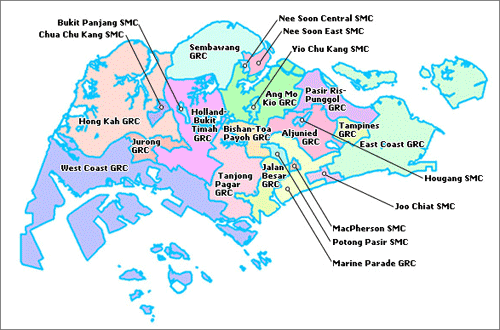
Wikipedia: Singapore General Elections
Labels: Come Grow With Me